Reaction-Diffusion: Turing Patterns From Two Chemicals
How two virtual chemicals, diffusing and reacting on a grid, produce stripes, spots, and mitosis-like splitting. The Gray-Scott model, Turing's mathematical sketch, and why biology still borrows from it.
In 1952, Alan Turing published a paper called "The Chemical Basis of Morphogenesis." It was his last substantial mathematical work before his death in 1954, and almost nobody read it at the time. It proposed something that sounded absurd: that the patterns on animal coats — stripes on a zebra, spots on a leopard, the mottled skin of a giant pufferfish — could emerge from the interaction of two chemicals diffusing and reacting inside a fertilized egg. Not from a genetic blueprint that specified each spot. Not from a template. From chemistry and geometry alone.
The idea was forgotten for nearly twenty years. When biologists and mathematicians returned to it in the 1970s and 1980s, they found that Turing's sketch, expanded into workable equations, produced patterns that looked strikingly like real biological ones. The model is now called reaction-diffusion, and the specific system most simulations use is the Gray-Scott model.
The Gray-Scott model
Two virtual chemicals, conventionally called A and B, live on a 2D grid. Both diffuse across the grid, but B diffuses faster than A. A is continually fed into the system at a rate F. B is continually drained out at a rate k. And B consumes A in the process of turning into more B.
The equations, in their discrete form on a grid, are:
- ∂A/∂t = D_A ∇²A − AB² + F(1 − A)
- ∂B/∂t = D_B ∇²B + AB² − (F + k)B
The first term in each is diffusion (the Laplacian ∇² spreads each chemical to its neighbors). The second term is the reaction (B consumes A and produces more B, proportional to A times B²). The third term is feed and drain: A is refilled toward 1, B is drained toward 0.
That is the whole model. Two chemicals, two parameters (F and k), two diffusion rates. There is no blueprint, no template, no instructions that say "put a stripe here."
The pattern regime
What makes the model interesting is that different combinations of F and k produce qualitatively different patterns. The space of (F, k) values is a map of regimes:
- Stripes and ridges at one corner of the parameter space — long, parallel, gently undulating lines that look like fingerprints or sand ripples.
- Spots and dots at another corner — circular B-rich regions surrounded by A-rich halos, arranged in roughly hexagonal lattices.
- Mitosis-like splitting in between — spots that grow, pinch, and divide into two, in a continuous process that looks uncomfortably like cell division.
- Chaos at the edges — traveling waves, oscillating spots, and unstable patterns that never settle.
The regimes are sharp. Move F by 0.001 and you can jump from spots to stripes. The boundaries between regimes are not well-behaved; they are fractal in places. This is why reaction-diffusion is a playground for exploration rather than a parameter you tune to a target — you do not design the pattern, you discover it.
Why biology still borrows it
Real biological patterning is more complicated than Turing's sketch. Genes do specify proteins, cells do communicate in more ways than diffusion, and the geometry of a developing embryo is not a flat 2D grid. But the core insight — that pattern can emerge from local interactions without a global blueprint — turns out to be broadly correct. Fish pigmentation, hair follicle spacing, the ridges on the roof of a mouse's mouth, and the digits on a vertebrate limb have all been linked to reaction-diffusion-like mechanisms in the last thirty years.
The model's value is not that it is a literal photograph of biology. Its value is that it shows how much structure you can get from how little mechanism. Two chemicals, two parameters, diffusion and reaction — and the output is a coat of spots.
A way to play with it
If you want to watch patterns form under your cursor, there is a Reaction Diffusion tool in Fluxcade. It runs the Gray-Scott model on the GPU via a WebGL fragment shader, so the simulation runs at full screen resolution rather than on a tiny grid. Click and drag on the canvas to inject the activator chemical and seed new growth. The feed and kill sliders in the right sidebar shift the pattern regime — move them a little and the pattern morphs between stripes, spots, and mitosis.
The chemical basis of morphogenesis is not a recipe for a pattern. It is a proof that pattern can exist without a recipe.
— Paraphrased from Turing (1952)
Turing's paper is seventy years old. The patterns it predicts are still being found in biology, and the model that produces them still fits in three lines of math.
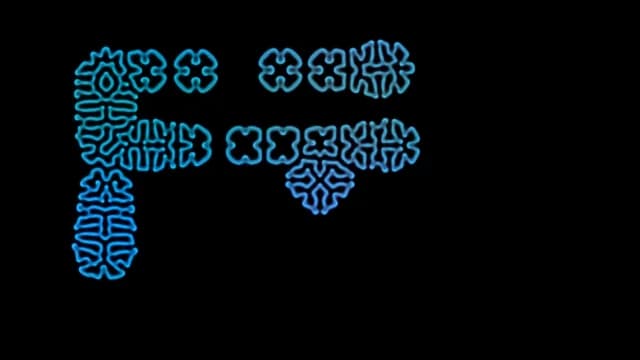
Reaction Diffusion
Paint and grow organic Turing patterns with the Gray-Scott reaction-diffusion model.