The Lorenz Attractor: A Butterfly From Three Equations
Three coupled ODEs, two parameters, and the defining picture of chaos. How the Lorenz system produces its iconic butterfly-wing trajectory — and why tiny changes in the start produce wildly different paths.
In 1963, Edward Lorenz was running a simplified model of atmospheric convection on a Royal McBee LGP-30 computer. The model was a system of three coupled ordinary differential equations — twelve multiplications and a handful of additions per timestep. He did not set out to discover chaos. He set out to model weather, and he got something stranger.
The equations are:
- dx/dt = σ(y − x)
- dy/dt = x(ρ − z) − y
- dz/dt = xy − βz
Three variables, three parameters. The standard values are σ = 10, ρ = 28, β = 8/3. With those numbers, the system does not settle to a fixed point, does not settle to a periodic orbit, and does not blow up. It traces a trajectory that lives on a structure — the Lorenz attractor — that looks like two interleaved scrolls, or a butterfly with its wings spread.
What the parameters do
σ is the Prandtl number, a measure of how fast the system diffuses. ρ is the Rayleigh number, a measure of how strongly the system is driven. β is a geometric factor. For low ρ, the system settles to one of two stable fixed points. Around ρ = 24.74, the fixed points lose stability and the trajectory begins to orbit them in an irregular, never-repeating pattern. This is the chaotic regime.
The iconic butterfly shape only appears in a specific window of ρ. Push ρ high enough and the system escapes to infinity. Push it low and the system dies at a fixed point. The butterfly is a transient, fragile object — a specific geometry that emerges from a specific balance of driving and damping.
Sensitive dependence
The defining property of the Lorenz system is sensitive dependence on initial conditions. Take two trajectories that start at points that differ by 0.0001 in any variable, run them forward, and within a few seconds of simulated time they are on opposite wings of the attractor. The system is deterministic — the same inputs always produce the same path — but the long-term future is effectively unpredictable because you can never measure the initial conditions with infinite precision.
This is where the famous "butterfly effect" metaphor comes from: a butterfly flaps its wings in Brazil, and the change propagates through the atmosphere until, weeks later, a tornado forms in Texas. The metaphor is popular because it is intuitive. The math behind it is less romantic: two trajectories that start arbitrarily close eventually diverge exponentially. The rate of that divergence is measured by the Lyapunov exponent, and for the Lorenz system it is positive, which is the technical signature of chaos.
Why it matters
The Lorenz attractor is not a model of any specific physical system. It is a model of a model — a stripped-down version of a fluid dynamics simulation that Lorenz could run on a 1960s computer. Its importance is conceptual rather than predictive. It showed, for the first time, that a deterministic system with a small number of variables and no randomness can produce behavior that is effectively unpredictable on long timescales.
Before Lorenz, the working assumption in many fields was that deterministic systems were predictable in principle — that with enough measurement precision and enough compute, you could forecast anything. After Lorenz, that assumption was dead. Weather forecasting, fluid dynamics, population biology, and economics all had to reckon with the fact that some systems are deterministic and unpredictable at the same time.
A way to see it
If you want to watch the attractor form in real time, there is a Lorenz Attractor tool in Fluxcade. Pick the classic parameters (σ = 10, ρ = 28, β = 8/3), watch the trajectory trace the butterfly, then nudge any parameter by a small amount and watch the shape morph. The simulation runs an RK integrator on the three ODEs and renders the path as a fading 3D trail you can rotate and zoom.
Chaos: when the present determines the future, but the approximate present does not approximately determine the future.
— Edward Lorenz
The Lorenz attractor is almost seventy years old. It remains the cleanest example of chaos most people will ever see — three equations, one butterfly, and the end of the idea that determinism means predictability.
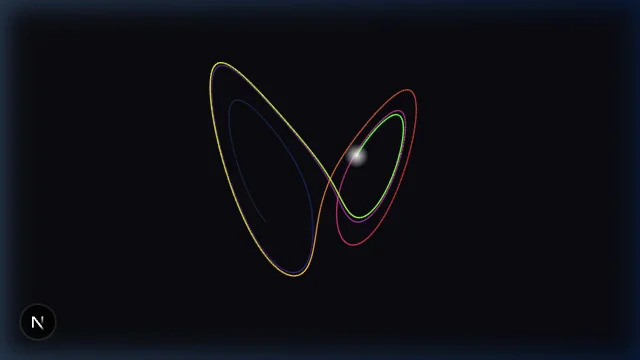
Lorenz Attractor
Chaotic 3D dynamical system with butterfly trails.