Loading FLUXCADE...
Fourier Series
Loading Fourier Series...
Fourier Series
MATHStudio
A Fourier epicycle drawer: sketch any path and watch rotating circles trace it out term by term.
UpdatedJan 2025
ExportsPNG, JPG
Runs onAny browser
PriceFree
Overview
A dynamic math playground.
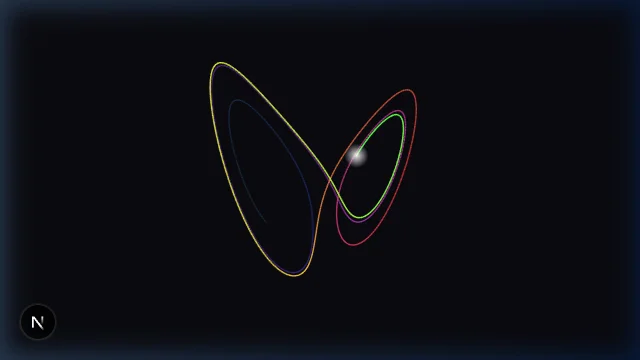
Fourier Series converts a closed drawing into its discrete Fourier coefficients, then re-renders it as a sum of rotating circles (epicycles). Each term is a circle; together they trace the original path.
Draw a shape with your mouse, then crank up the number of terms to see the approximation converge. It's a hands-on way to feel what the Fourier transform actually does.
Features
Built for math-scale experimentation.
01 / Spotlight
Discrete Fourier transform
Of a user-drawn path, with adjustable term count.
02
Each term is
Rendered as a rotating epicycle; the sum traces the original shape.
03
Runs in real
Time. Export PNG or JPG to save a frame.
How to use
Workflow
Steps take about a minute.
Draw a closed path on the canvas with your mouse, then release. Use the term-count slider in the sidebar to add or remove epicycles and watch the trace converge on your shape. Export PNG/JPG from the toolbar.
Use cases
What people use it for
Visualizing the Fourier transform and epicycle constructionTeaching signal processing and frequency decompositionDrawing with rotating circles for math art and demosExploring the Gibbs phenomenon at sharp corners
FAQ
Common questions
Why does the trace overshoot at sharp corners?+
Fourier series approximate continuous, well-behaved functions well. Sharp corners require high-frequency terms; with few terms the trace will round them off. Raise the term count for tighter corners.
Do I need to close the path?+
Yes. The discrete Fourier transform assumes a periodic signal, so an open path is implicitly closed from its end back to its start. The trace will look weird if the start and end points don't roughly match.
Related
More math apps
Fourier Series
MATHStudio
A Fourier epicycle drawer: sketch any path and watch rotating circles trace it out term by term.
UpdatedJan 2025
ExportsPNG, JPG
Runs onAny browser
PriceFree
Overview
A dynamic math playground.
Fourier Series converts a closed drawing into its discrete Fourier coefficients, then re-renders it as a sum of rotating circles (epicycles). Each term is a circle; together they trace the original path.
Draw a shape with your mouse, then crank up the number of terms to see the approximation converge. It's a hands-on way to feel what the Fourier transform actually does.
Features
Built for math-scale experimentation.
01 / Spotlight
Discrete Fourier transform
Of a user-drawn path, with adjustable term count.
02
Each term is
Rendered as a rotating epicycle; the sum traces the original shape.
03
Runs in real
Time. Export PNG or JPG to save a frame.
How to use
Workflow
Steps take about a minute.
Draw a closed path on the canvas with your mouse, then release. Use the term-count slider in the sidebar to add or remove epicycles and watch the trace converge on your shape. Export PNG/JPG from the toolbar.
Use cases
What people use it for
Visualizing the Fourier transform and epicycle constructionTeaching signal processing and frequency decompositionDrawing with rotating circles for math art and demosExploring the Gibbs phenomenon at sharp corners
FAQ
Common questions
Why does the trace overshoot at sharp corners?+
Fourier series approximate continuous, well-behaved functions well. Sharp corners require high-frequency terms; with few terms the trace will round them off. Raise the term count for tighter corners.
Do I need to close the path?+
Yes. The discrete Fourier transform assumes a periodic signal, so an open path is implicitly closed from its end back to its start. The trace will look weird if the start and end points don't roughly match.
Related