Loading FLUXCADE...
Black Hole
Loading Black Hole...
Black Hole
PHYSICSStudio
A relativistic black hole simulator featuring gravitational lensing, Doppler beaming, and photon ring physics.
UpdatedJan 2025
ExportsPNG
Runs onAny browser
PriceFree
Overview
A dynamic physics playground.
Black Hole is an interactive relativistic simulator. It features real-time gravitational lensing (Einstein ring light deflection), warping background stars behind the shadow.
It also models relativistic Doppler beaming, making matter rotating towards the observer brighter and bluer (blueshift) and receding matter dimmer and redder (redshift). Tweak accretion suction, Schwarzschild gravity, event horizon size, and configure bipolar relativistic jets with custom temperature profiles.
Features
Built for physics-scale experimentation.
01 / Spotlight
Relativistic lensing
Real-time General Relativity light bending visible around the event horizon.
02
Doppler boosting
Relativistic Doppler beaming and redshift based on line-of-sight velocity.
03
Event horizon features
Configurable photon orbit ring, event horizon silhouette, and bipolar jets.
04
Accretion particles
Glowing accretion disk with temperature-based color profiles.
How to use
Workflow
Steps take about a minute.
Rotate the camera in 3D to see how gravitational lensing warps the accretion disk around the event horizon. Tune Schwarzschild gravity, accretion suction, and disk boundaries. Adjust lensing strength, Doppler beaming intensity, or enable relativistic jets in the sidebar controls.
Use cases
What people use it for
Demonstrating gravitational lensing and General Relativity concepts visuallyExploring relativistic Doppler beaming and redshift in accretion disksSimulating matter accretion, event horizon capture, and relativistic jetsGenerating sci-fi film style black hole visuals and stills
FAQ
Common questions
Why does the back of the accretion disk appear warped above and below the black hole?+
This is gravitational lensing. General relativity states that a massive body bends spacetime and light paths. Light from the back of the disk is bent around the event horizon towards the camera, producing the classic Interstellar halo look.
What causes the disk to be much brighter on one side?+
This is relativistic Doppler beaming (or Doppler boosting). Matter rotating towards the camera at a fraction of the speed of light is blueshifted and appears brighter, while receding matter is redshifted and appears dimmer.
Related
More physics apps
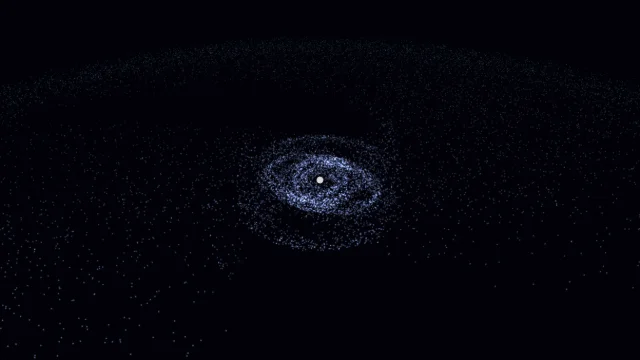
Galaxy Sim
Simulate spiral galaxies, dark matter effects, and galaxy collisions in real time.

Fluid Dynamics
Inject colorful dye into a real-time fluid and watch it swirl.
Wave Sim
Create water ripples and watch them interact with realistic wave interference.

Double Pendulum
Simulate chaotic motion with physics.
Black Hole
PHYSICSStudio
A relativistic black hole simulator featuring gravitational lensing, Doppler beaming, and photon ring physics.
UpdatedJan 2025
ExportsPNG
Runs onAny browser
PriceFree
Overview
A dynamic physics playground.
Black Hole is an interactive relativistic simulator. It features real-time gravitational lensing (Einstein ring light deflection), warping background stars behind the shadow.
It also models relativistic Doppler beaming, making matter rotating towards the observer brighter and bluer (blueshift) and receding matter dimmer and redder (redshift). Tweak accretion suction, Schwarzschild gravity, event horizon size, and configure bipolar relativistic jets with custom temperature profiles.
Features
Built for physics-scale experimentation.
01 / Spotlight
Relativistic lensing
Real-time General Relativity light bending visible around the event horizon.
02
Doppler boosting
Relativistic Doppler beaming and redshift based on line-of-sight velocity.
03
Event horizon features
Configurable photon orbit ring, event horizon silhouette, and bipolar jets.
04
Accretion particles
Glowing accretion disk with temperature-based color profiles.
How to use
Workflow
Steps take about a minute.
Rotate the camera in 3D to see how gravitational lensing warps the accretion disk around the event horizon. Tune Schwarzschild gravity, accretion suction, and disk boundaries. Adjust lensing strength, Doppler beaming intensity, or enable relativistic jets in the sidebar controls.
Use cases
What people use it for
Demonstrating gravitational lensing and General Relativity concepts visuallyExploring relativistic Doppler beaming and redshift in accretion disksSimulating matter accretion, event horizon capture, and relativistic jetsGenerating sci-fi film style black hole visuals and stills
FAQ
Common questions
Why does the back of the accretion disk appear warped above and below the black hole?+
This is gravitational lensing. General relativity states that a massive body bends spacetime and light paths. Light from the back of the disk is bent around the event horizon towards the camera, producing the classic Interstellar halo look.
What causes the disk to be much brighter on one side?+
This is relativistic Doppler beaming (or Doppler boosting). Matter rotating towards the camera at a fraction of the speed of light is blueshifted and appears brighter, while receding matter is redshifted and appears dimmer.
Related
More physics apps
Galaxy Sim
Simulate spiral galaxies, dark matter effects, and galaxy collisions in real time.
Fluid Dynamics
Inject colorful dye into a real-time fluid and watch it swirl.
Wave Sim
Create water ripples and watch them interact with realistic wave interference.
Double Pendulum
Simulate chaotic motion with physics.