Loading FLUXCADE...
Galaxy Sim
Loading Galaxy Sim...
Galaxy Sim
PHYSICSStudio
A galaxy simulator with multiple structural shapes, dark matter velocity curves, and real-time dwarf galaxy merger collisions.
UpdatedJan 2025
ExportsPNG
Runs onAny browser
PriceFree
Overview
A dynamic physics playground.
Galaxy Sim is a dynamic astrophysical playground. It simulates stellar orbits using a configurable rotation curve—allowing you to toggle between point-mass Keplerian gravity and flat rotation curves powered by a dark matter halo.
Choose between Spiral, Barred Spiral, Elliptical, or Ring galaxies. Enable the merger system to spawn a dwarf galaxy companion and watch tidal tails, bridges, and gravity disruptions unfold in real time. Customize star populations with custom colors and glowing effects.
Features
Built for physics-scale experimentation.
01 / Spotlight
Four galaxy structures
Spiral, Barred Spiral, Elliptical, and Ring—each with its own density and arm logic.
02
Real merger physics
Spawn a dwarf companion and watch tidal tails and bridges form.
03
Dark matter halo
Flat rotation curves vs. Keplerian point-mass behavior.
04
Velocity dispersion
Tune scatter to mimic realistic stellar populations.
05
Glowing visuals
Color and glow controls for star populations.
How to use
Workflow
Steps take about a minute.
Select a structure type and rotation model from the panel, then tune radius, arms, spin, and velocity dispersion. Toggle the Galaxy Collision switch to launch a companion dwarf galaxy, then watch the collision and merging process evolve. Drag to rotate the 3D camera and scroll to zoom.
Use cases
What people use it for
Visualizing spiral, barred, and elliptical galaxy structures for physics educationSimulating galactic mergers, tidal tails, and gravitational disruptionsDemonstrating dark matter effects on galactic rotation curvesCreating high-resolution space backgrounds and stellar art
FAQ
Common questions
How is the dwarf galaxy collision simulated?+
When active, we split the star count between the main and dwarf galaxies. The two massive galactic cores orbit under mutual gravity, and stars from both galaxies dynamically respond to the gravitational forces of both centers. This creates authentic tidal tails and bridge structures.
What does the Dark Matter option change?+
In classical Keplerian gravity, orbital speeds fall off like 1/sqrt(r), meaning outer stars rotate slower. The flat rotation model adds a simulated dark matter halo force, keeping speeds constant at large radii—matching observations of real galaxies.
Related
More physics apps
Black Hole
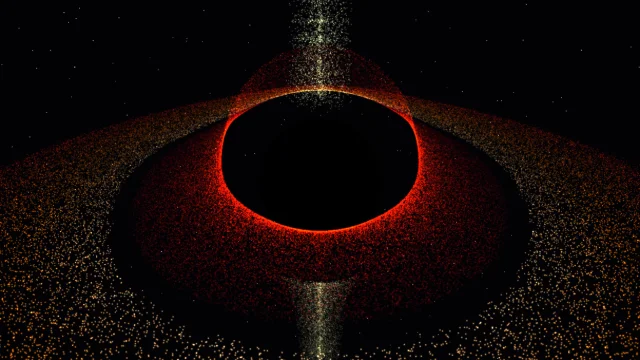
Visualize a black hole with gravitational lensing, Doppler beaming, and an accretion disk.
Fluid Dynamics
Inject colorful dye into a real-time fluid and watch it swirl.
Wave Sim
Create water ripples and watch them interact with realistic wave interference.
Double Pendulum
Simulate chaotic motion with physics.
Galaxy Sim
PHYSICSStudio
A galaxy simulator with multiple structural shapes, dark matter velocity curves, and real-time dwarf galaxy merger collisions.
UpdatedJan 2025
ExportsPNG
Runs onAny browser
PriceFree
Overview
A dynamic physics playground.
Galaxy Sim is a dynamic astrophysical playground. It simulates stellar orbits using a configurable rotation curve—allowing you to toggle between point-mass Keplerian gravity and flat rotation curves powered by a dark matter halo.
Choose between Spiral, Barred Spiral, Elliptical, or Ring galaxies. Enable the merger system to spawn a dwarf galaxy companion and watch tidal tails, bridges, and gravity disruptions unfold in real time. Customize star populations with custom colors and glowing effects.
Features
Built for physics-scale experimentation.
01 / Spotlight
Four galaxy structures
Spiral, Barred Spiral, Elliptical, and Ring—each with its own density and arm logic.
02
Real merger physics
Spawn a dwarf companion and watch tidal tails and bridges form.
03
Dark matter halo
Flat rotation curves vs. Keplerian point-mass behavior.
04
Velocity dispersion
Tune scatter to mimic realistic stellar populations.
05
Glowing visuals
Color and glow controls for star populations.
How to use
Workflow
Steps take about a minute.
Select a structure type and rotation model from the panel, then tune radius, arms, spin, and velocity dispersion. Toggle the Galaxy Collision switch to launch a companion dwarf galaxy, then watch the collision and merging process evolve. Drag to rotate the 3D camera and scroll to zoom.
Use cases
What people use it for
Visualizing spiral, barred, and elliptical galaxy structures for physics educationSimulating galactic mergers, tidal tails, and gravitational disruptionsDemonstrating dark matter effects on galactic rotation curvesCreating high-resolution space backgrounds and stellar art
FAQ
Common questions
How is the dwarf galaxy collision simulated?+
When active, we split the star count between the main and dwarf galaxies. The two massive galactic cores orbit under mutual gravity, and stars from both galaxies dynamically respond to the gravitational forces of both centers. This creates authentic tidal tails and bridge structures.
What does the Dark Matter option change?+
In classical Keplerian gravity, orbital speeds fall off like 1/sqrt(r), meaning outer stars rotate slower. The flat rotation model adds a simulated dark matter halo force, keeping speeds constant at large radii—matching observations of real galaxies.
Related
More physics apps
Black Hole
Visualize a black hole with gravitational lensing, Doppler beaming, and an accretion disk.
Fluid Dynamics
Inject colorful dye into a real-time fluid and watch it swirl.
Wave Sim
Create water ripples and watch them interact with realistic wave interference.
Double Pendulum
Simulate chaotic motion with physics.