Loading FLUXCADE...
Double Pendulum
Loading Double Pendulum...
Double Pendulum
PHYSICSStudio
A real-time double pendulum chaos simulator with adjustable lengths, masses, gravity, and a fading trail.
UpdatedJan 2025
ExportsPNG, JPG
Runs onAny browser
PriceFree
Overview
A dynamic physics playground.
Double Pendulum solves the equations of motion for two rigid links connected at a pivot. The system is famously chaotic: identical initial conditions can diverge within a few seconds.
Drag the bobs to set a starting configuration, then watch the trail trace the second bob's path. Adjust the rod lengths, masses, gravity, and trail length in the sidebar to explore different regimes.
Features
Built for physics-scale experimentation.
01 / Spotlight
Real-time physics integration
Of two linked pendulum arms.
02
Tunable rod lengths
Bob masses, gravity, and trail fade for a single or multi-pendulum look.
03
Drag the bobs
To reposition; the trail traces the second bob's path through phase space.
How to use
Workflow
Steps take about a minute.
Drag either bob to set a starting angle, then let go. Use the sidebar to tune rod lengths, masses, gravity, and trail length. Use Reset to clear the trail, and Export PNG/JPG to save a snapshot.
Use cases
What people use it for
Demonstrating chaos theory and sensitive dependence on initial conditionsLearning about coupled equations of motion and pendulum mechanicsGenerating phase-space trail art for posters or coversInteractive physics demos for classrooms or presentations
FAQ
Common questions
Is this real double-pendulum physics?+
Yes. The solver integrates the full coupled equations of motion for two rigid links under gravity, with the standard small-angle caveat: very high speeds can introduce numerical error.
Why does the trail look different every time I run it?+
The system is chaotic — tiny changes in the starting angle or mass produce wildly different paths. Even with the same slider settings, two runs won't trace the same shape.
Related
More physics apps
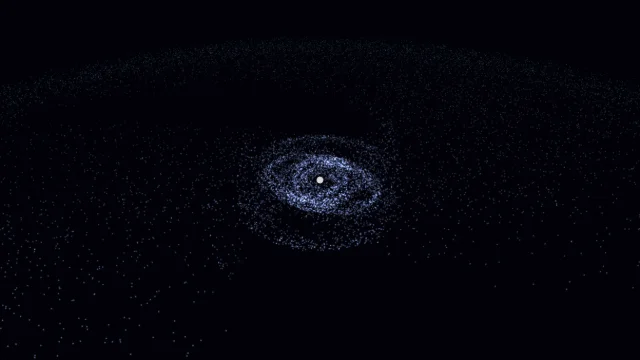
Galaxy Sim
Simulate spiral galaxies, dark matter effects, and galaxy collisions in real time.
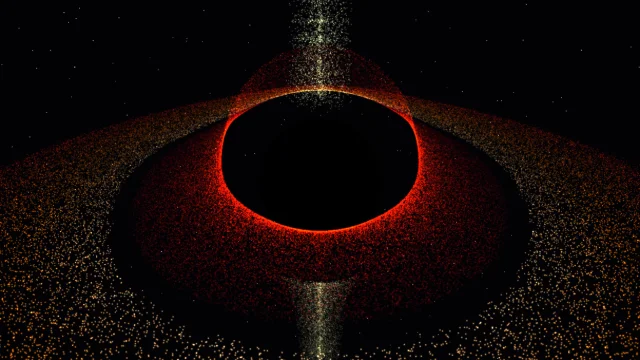
Black Hole
Visualize a black hole with gravitational lensing, Doppler beaming, and an accretion disk.

Fluid Dynamics
Inject colorful dye into a real-time fluid and watch it swirl.
Wave Sim
Create water ripples and watch them interact with realistic wave interference.
Double Pendulum
PHYSICSStudio
A real-time double pendulum chaos simulator with adjustable lengths, masses, gravity, and a fading trail.
UpdatedJan 2025
ExportsPNG, JPG
Runs onAny browser
PriceFree
Overview
A dynamic physics playground.
Double Pendulum solves the equations of motion for two rigid links connected at a pivot. The system is famously chaotic: identical initial conditions can diverge within a few seconds.
Drag the bobs to set a starting configuration, then watch the trail trace the second bob's path. Adjust the rod lengths, masses, gravity, and trail length in the sidebar to explore different regimes.
Features
Built for physics-scale experimentation.
01 / Spotlight
Real-time physics integration
Of two linked pendulum arms.
02
Tunable rod lengths
Bob masses, gravity, and trail fade for a single or multi-pendulum look.
03
Drag the bobs
To reposition; the trail traces the second bob's path through phase space.
How to use
Workflow
Steps take about a minute.
Drag either bob to set a starting angle, then let go. Use the sidebar to tune rod lengths, masses, gravity, and trail length. Use Reset to clear the trail, and Export PNG/JPG to save a snapshot.
Use cases
What people use it for
Demonstrating chaos theory and sensitive dependence on initial conditionsLearning about coupled equations of motion and pendulum mechanicsGenerating phase-space trail art for posters or coversInteractive physics demos for classrooms or presentations
FAQ
Common questions
Is this real double-pendulum physics?+
Yes. The solver integrates the full coupled equations of motion for two rigid links under gravity, with the standard small-angle caveat: very high speeds can introduce numerical error.
Why does the trail look different every time I run it?+
The system is chaotic — tiny changes in the starting angle or mass produce wildly different paths. Even with the same slider settings, two runs won't trace the same shape.
Related
More physics apps
Galaxy Sim
Simulate spiral galaxies, dark matter effects, and galaxy collisions in real time.
Black Hole
Visualize a black hole with gravitational lensing, Doppler beaming, and an accretion disk.
Fluid Dynamics
Inject colorful dye into a real-time fluid and watch it swirl.
Wave Sim
Create water ripples and watch them interact with realistic wave interference.